

About Antarctica
Antarctica, on average, is the coldest, driest, and windiest continent, and has the highest average elevation of all the continents. Antarctica is considered a desert, with annual precipitation of only 200 mm along the coast and far less inland. There are no permanent human residents, but anywhere from 1,000 to 5,000 people reside throughout the year at the research stations scattered across the continent.
There are lots of penguins, whales, seals, krill (the main food for whales), and even fish in Antarctica's waters, but there are no land mammals.
Eskimos and polar bears are found in the ARCTIC (northern hemisphere), not the Antarctic.
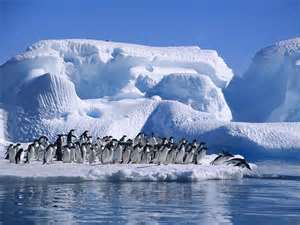
The Antarctic Treaty was signed in 1959 by 12 countries; to date, 49 countries have signed the treaty. The treaty prohibits military activities and mineral mining, prohibits nuclear explosions and nuclear waste disposal, supports scientific research, and protects the continent's ecozone.
Climate
Antarctica is the coldest place on earth with the mean annual temperature at the South Pole being minus -49 degrees. Luckily the place we will visit (Antarctic Peninsular) is quite a bit warmer. The west coast of the peninsular has the mildest Antarctic temperatures. The temperatures exceed 0°C for 3-4 months during the summer, and rarely fall below -10°C during the winter.
To view current weather conditions on the Antarctic Peninsular, please click here: http://ebase.2041.com/2009/
The coldest temperature ever recorded on earth was -89.2 degrees in 1983 at a Russian Antarctic base.
Geography
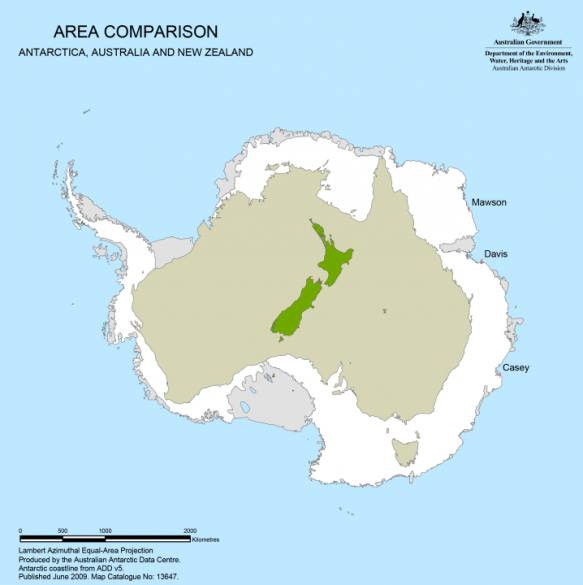 The continent is roughly 14 million square kilometres. Australia is only 9 million square kilometres.
An ice sheet covers all but 2.4 percent of Antarctica's 14 million square kilometers.
At its thickest point the ice sheet is 4,776 meters deep and averages 2,160 meters thick. This is 90 percent of all the world's ice and it is 70 percent of all the world's fresh water. If all of this ice were to melt, sea levels across the world would rise about 60m!
Without any ice, Antarctica would emerge as an archipelago of mountainous islands, known as Lesser Antarctica, and a single large landmass about the size of Australia, known as Greater Antarctica. These regions have different geologies.
Greater Antarctica, or East Antarctica, is composed of older, igneous and metamorphic rocks. Lesser Antarctica, or West Antarctica, is made up of younger, volcanic and sedimentary rock. Lesser Antarctica, in fact, is part of the “Ring of Fire,” a tectonically active area around the Pacific Ocean. Tectonic activity is the interaction of plates on the Earth’s crust, often resulting in earthquakes and volcanoes. Mount Erebus, located on Antarctica’s Ross Island, is the southernmost active volcano on Earth.
Science
Scientists work on all kinds of unique projects in Antarctica, including penguins, Antarctic cod (they have a special antifreeze agent in their blood!), whales, seals, global warming, climatology, meteorites, glaciology, astronomy, volcanoes, UV radiation, and more. Scientists also study humans in Antarctica, doing research on how the human body adapts to cold and how the human mind and heart react to extreme isolation.
Climate Change
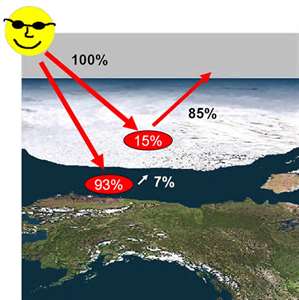 The Antarctic region has an important role in global climate processes. It is an integral part of the Earth’s heat balance. The heat balance, also called the energy balance, is the relationship between the amount of solar heat absorbed by Earth’s atmosphere and the amount of heat reflected back into space.
Antarctica has a larger role than most continents in maintaining the Earth’s heat balance. Ice is more reflective than land or water surfaces. The massive Antarctic ice sheet reflects a large amount of solar radiation away from the Earth’s surface. As global ice cover (ice sheets and glaciers) decreases, the reflectivity of Earth’s surface also decreases. This allows more incoming solar radiation to be absorbed by the Earth’s surface, causing an unequal heat balance linked to global warming, the current period of climate change.
Interestingly, NASA scientists have found that climate change has actually caused more ice to form in some parts of Antarctica. They say this is happening because of new climate patterns caused by climate change. These patterns create a strong wind pattern called the "polar vortex." Polar vortex winds lower temperatures in the Antarctic and have been building in strength in recent decades—as much as 15 percent since 1980. This effect is not seen throughout the Antarctic, however, and some parts are experiencing ice melt.
Ocean Currents
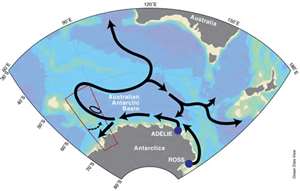 The waters surrounding Antarctica are a key part of the “ocean conveyor belt,” a global system in which water circulates around the globe based on density and on currents. The cold waters surrounding Antarctica, known as the Antarctic Bottom Water, are so dense that they push against the ocean floor. The Antarctic Bottom Water causes warmer waters to rise, or upwell.
Antarctic upwelling is so strong that it helps move water around the entire planet. This movement is aided by strong winds that circumnavigate Antarctica. Without the aid of the oceans around Antarctica, the Earth’s waters would not circulate in a balanced and efficient manner.
History
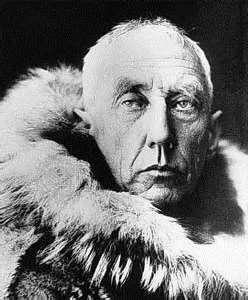 The Antarctic continent was first seen in 1820. The first documented landing on mainland Antarctica was by the American sealer John Davis in West Antarctica in 1821. It was 1935 before the first woman set foot there. Her name was Catherine Mikkelson, and she was the wife of a Norwegian whaling captain. The South Pole was first reached by a Norwegian named Roald Amundsen in 1911, and shortly after by British explorer Robert Scott.
Tourism
Most tourists who visit Antarctica visit the Antarctic Peninsula, which is accessible from Chile. There the climate is mild in comparison with the rest of the continent, and is teaming with wildlife. This part of Antarctica is sometimes called the "Banana Belt."
In the 2011/2012 season there were 26,509 tourists, the peak was the 2007/2008 season with 46,000 visitors.
Fauna
All warm-blooded animals living on and around Antarctica: whales, seals, sea birds, penguins, rely on thick layers of blubber to insulate them from the cold. The layer of blubber on a Weddell seal can be up to 4 inches thick.
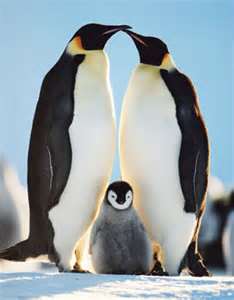 Only one warm-blooded animal remains on the Antarctic continent during the bitter winter, the Emperor Penguin. Emperor Penguin females lay one egg in June and leave to spend the winter at sea. The male penguins stay on land all winter, surviving the most extreme conditions for nine weeks (including no food!), keeping their one egg warm by balancing it on their feet and covering it with a flap of abdominal skin. The females return just about the time the eggs hatch.
Only invertebrate animals live on the continent year-round. The largest invertebrate that makes its home permanently in Antarctica is a wingless midge called Beligica Antarctica. It is so tiny it can only be seen well under a microscope.
One of the most important animals in the seas around Antarctica is the Krill, a tiny crustacean that is the main food source for Baleen Whales, Crabeater Seals, Fur Seals and Adelie Penguins. Krill are crucial to the health and ecological balance of all the world's oceans.
There are many different species of penguins in Antarctica, including the huge and colorful Emperor Penguin, the smaller Adelie, the Gentoo, the Chinstrap Penguin, the Rockhopper, the King, the Macaroni and more. In all there are 21 species of penguin scattered throughout the southern hemisphere. Penguins are great swimmers. They can swim so fast, if they're trying, for instance, to escape the jaws of a Leopard Seal, that they can shoot out of the water 7 feet into the air onto a safe ice floe.
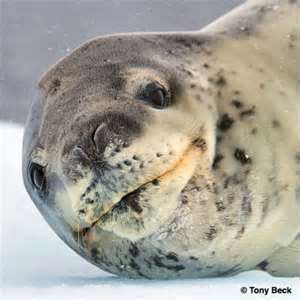 Seals in Antarctic waters include the Weddell Seal, the Ross Seal, the Crabeater, and the Leopard Seal. On the Antarctic peninsula there are also Elephant Seals and Fur Seals. These southern seals are still recovering from the devastation wrought by the 19th century sealers.
Six species of Baleen Whales and six species of Toothed Whales and dolphins are found in Antarctic waters. They include the Blue, Fin, Southern Right Whale, Sei Whale, Minke, and Humpback; the Sperm Whale, Killer Whale, Hourglass Dolphin, Fourtooth Whale, Rightwhale Dolphin and the Southern Bottlenose Whale.
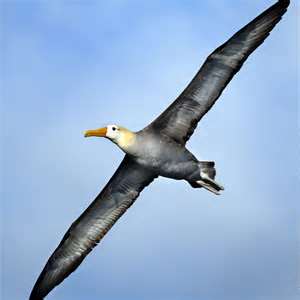 Penguins are the group of Antarctic birds that everyone thinks of first, but there are actually more Petrels than there are penguins! Petrels include Albatrosses, Fulmars, Prions, Shearwaters, Storm Petrels, Diving Petrels and Gadfly Petrels. Petrels are found in all the world's oceans, but there are more in Antarctic waters than anywhere else.
Other birds that live in or breed in Antarctica include Cormorants, Gulls, Skuas and Terns and Land Birds including Sheathbills and Pintail Ducks.
Flaura
Plants grow in Antarctica in ice-free regions (only about 2 percent of the continent is ice-free). Lichens and moss grow in any favourable niche, including in sand, soil, rock and on the weathered bones and feathers of dead animals. Algae also grows in Antarctica.
Fifty million years ago Antarctica had a temperate climate, evergreen forests and many more kinds of animals than it has today. As the icecap slowly formed, most of the animals that lived there in ancient times were obliterated. Evidence of this once warm climate is in the fossils of plants, including fossil ferns, found by scientists.
